
In The Abstract: Orienting Abstraction in Black Femininity
by Sika Bonsu
The illusion that abstraction exists separate from the body, as a detached and purified aesthetic terrain, is a fantasy sustained by power.
Under the Western gaze, the body is positioned through shifting conditions of control, access, and confinement, often determined by one’s proximity to whiteness, masculinity, and capital. In other words, think of the body as the concrete form, while identity becomes one’s capacity to move through and beyond it, extending personhood past the limits imposed upon the flesh. Within this condition, abstraction is no longer purely an artistic strategy or formal exercise, but a mode of conceptual freedom unevenly granted through institutional and cultural structures of power.
The work of us Black women artists exposes the limits of the Western construction of abstraction by revealing how our bodies have historically been used for social projection rather than recognized for our individual innate intellectual, creative, and reality-shaping capacities. As a result, we inherit gaps produced through the systematic misrecognition of our foremothers, whose conceptual complexity was routinely discounted by structures never designed to engage Black women’s lived realities as sites of serious inquiry.
The questions that remain for me are as follows:
How can a system designed to limit our personhood ever truly offer us expansive territory?
What has this done to the lineage through which our foremothers’ contributions are understood?
As Black women artists working across methods and mediums, what lineage do we now find ourselves within, and what are we actively constructing?
At this point, the ongoing polarization between figuration and abstraction within Black artistic practice feels entirely insufficient and, honestly, irrelevant. Whether a Black artist works with the figure and chooses to center the political or abandons those concerns altogether, neither guarantees transcendence from the racial logics that structure the (mis-)recognition of our humanity. There is no neutral ground for Black women artists within institutions historically built to legitimize the work of white men and sustain the Western gaze.
If we look back at the cultural movements of the Harlem Renaissance and the Black Power Movement, mainstream culture was forced to recognize and take the work of Black artists seriously. However, this inclusion exposed the fragility of a system whose legitimacy depends upon the maintenance of white supremacy. Drawing on Ngũgĩ wa Thiong’o’s concepts established in Decolonising the Mind: The Politics of Language in African Literature, the emergence of Black artists during these moments can be understood as a refusal to accept Eurocentric frameworks as the universal standard for truth (1).
Rejecting distorted assumptions about Black life, they asserted alternative ways of knowing, being, creating, and relating to time grounded in their own cultural and intellectual traditions. Their presence in these institutions were structurally disruptive because it revealed that artistic legitimacy had never been neutral, but rather organized around the maintenance of whiteness as the measure of artistic value. In response, the art world recalibrated its criteria of legitimacy, elevating a new figure of the “serious artist” defined through distance from cultural and political concerns and oriented instead toward transcendence and formal experimentation. Within this climate, abstraction became increasingly synonymous with purity, universality, and intellectual authority, qualities institutionally secured through the ability of white male artists to detach from the social realities still projected onto others. Power became obscured through the artist’s ability to detach from social reality and approach the work through formal concerns alone, masking the racial and gendered structures that enabled such freedom.
An exhibition that played a large contribution to this shift was Cubism and Abstract Art, curated by the Museum of Modern Art's first director, Alfred H. Barr Jr., in 1936. The exhibition emerged during a period marked by the rise of fascism across Europe, when avant-garde artists faced increasing censorship, political repression, and public skepticism regarding the value and purpose of their work. The extent of this skepticism is evident in the challenges Barr encountered while organizing the exhibition. At one point, customs officials refused to recognize several works as art, instead classifying them along the lines of architectural materials and subjecting them to additional fees (2). Against this backdrop, Barr sought to create an exhibition that would legitimize abstraction by situating it within a coherent historical lineage rooted in European avant-garde traditions (3). In doing so, Cubism and Abstract Art helped establish abstraction not only as a “serious artistic practice” but as a vehicle for creative freedom, shaping how generations of people would come to understand its history and significance.
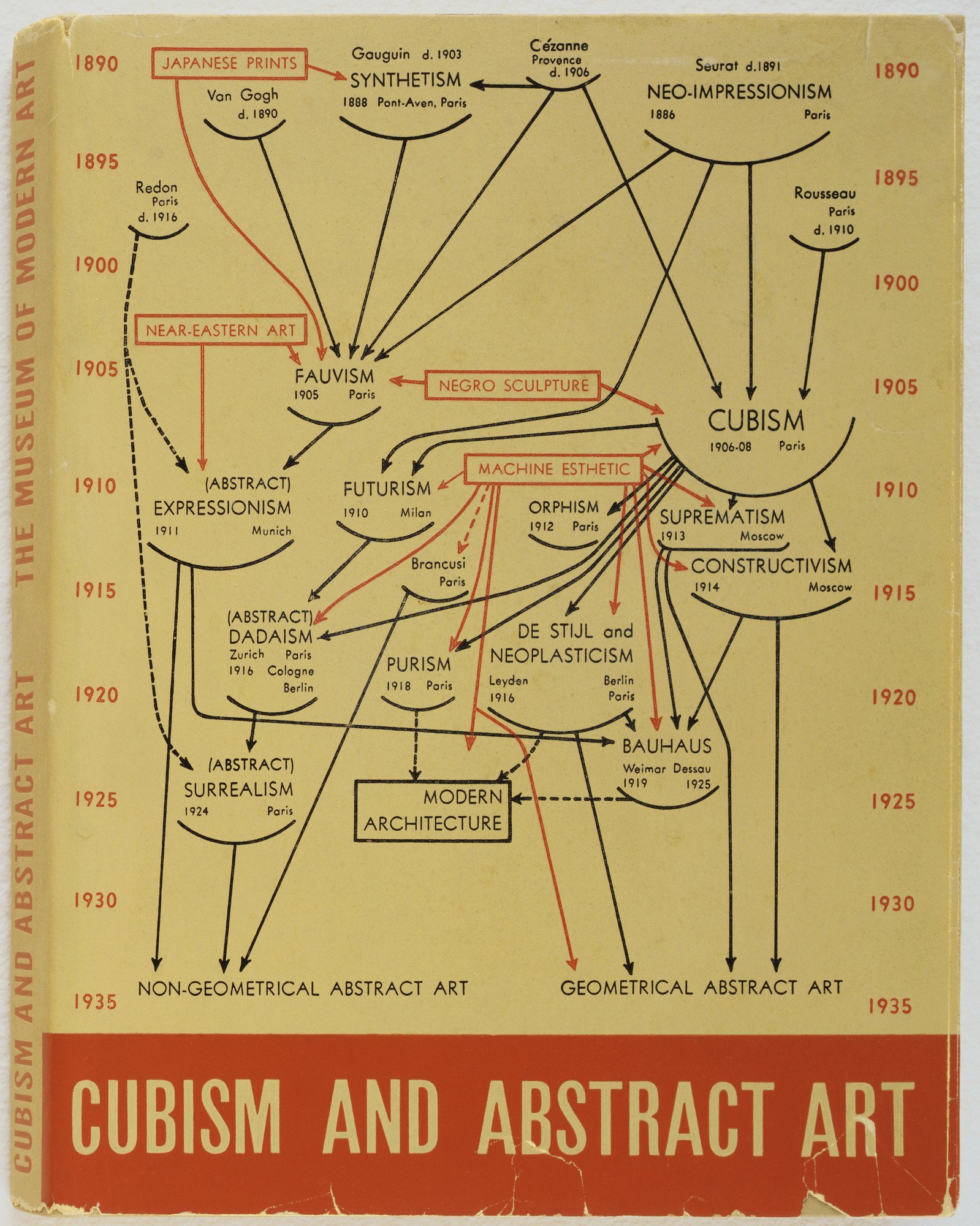
Figure 1. Catalog cover of Cubism and Abstract Art. Scan taken by the Museum of Modern Art, 2017. Accessed March 3, 2025, www.moma.org/calendar/exhibitions/2748.
I want to begin with the genealogical diagram on the catalog’s front cover (Fig. 1) because it sets the tone by referencing “Negro Sculpture” while simultaneously positioning it on the outskirts of abstraction’s core lineage. A subtle action that frames Black artistic production as primitive source material waiting to be reworked into modernity through European formal experimentation. As the exhibition’s paratext, the diagram helped codify how viewers understood the origins of modernism, even beyond the exhibition itself. In other words, one did not need to attend the exhibition or even read the catalog to understand the throughline Barr was authoring. His reference to “Negro Sculpture” appears only through its relation to Cubism and Fauvism rather than as an artistic tradition with its own intellectual and formal concerns, a logic that continues in the exhibition’s master checklist (4). While European works were attributed to specific artists and accompanied by biographies and exhibition histories, the five African sculptures included in the show were identified only by region (a common ethnographic strategy used to create distance between works produced outside the Western canon).
It is important here that we interrogate the power of language and naming. By referring to sculptures from various regions across West Africa as “Negro Sculpture” rather than African sculpture, Barr collapsed distinct artistic traditions into a racial category that could also be mapped onto African American artists working during that period. In turn, the ethnographic framing of these sculptures helped obscure the possibility of fully recognizing African American artists as artists in their own right because their history remained outside the lineage Barr was attempting to construct.
These curatorial decisions enable us to see how Black artistic production was absorbed into the history of abstraction while the people responsible for its creation remained structurally illegible as artists. Barr's treatment of African sculpture is also instructive because it mirrors the definition of abstraction he would go on to formalize within the exhibition catalog. He defined the term as both a process and a style. Abstraction, for him, involved drawing away from a source, resulting in forms that departed from realism and literal representation (5). We can see how this definition assumes a particular understanding of abstraction rooted in distance and separation from reality. Missing, however, is any consideration of how abstraction may have been understood and practiced across other cultural traditions.
It was this limitation that led me to Thelma Johnson Street. As I continued researching not only this exhibition but the broader history of the Museum of Modern Art, I became increasingly perplexed by how the acquisition of Rabbit Man in 1942 challenged the very lineage and understanding of abstraction that Barr had established through Cubism and Abstract Art. A small gouache painting measuring just 6 by 4 inches, Rabbit Man was the first work created by a Black woman to enter MoMA’s permanent collection. The piece depicts an elongated figure with outstretched arms marked by geometric patterns in red, gray, and black. While the work itself remains sparsely documented, Streat’s practice was shaped by sustained engagement with the cultures she encountered through her travels to places such as New Mexico, British Columbia, Australia, Indonesia, and Haiti (6). She often translated these encounters through movement and masquerade, employing both as conceptual and formal strategies that positioned her work as a site of connection and transmission rather than separation. Scholars have also noted the affinity between Rabbit Man and Kota reliquary figures from Gabon, objects historically used to guard ancestral remains (7). When considered alongside the significance of the rabbit within folklore traditions across the Black Diaspora, we see the rabbit as a trickster figure who survives through cunning and subversion. What makes Streat’s work so compelling is her ability to embed layers of symbolism that reveal how abstraction has long functioned within Black diasporic traditions as a language for transmitting moral, spiritual, and communal knowledge while remaining largely opaque to dominant modes of interpretation. Her practice suggests that Black diasporic communities were already engaging abstraction as a method of translating memory, folklore, spirituality, movement, and collective experience into visual language.
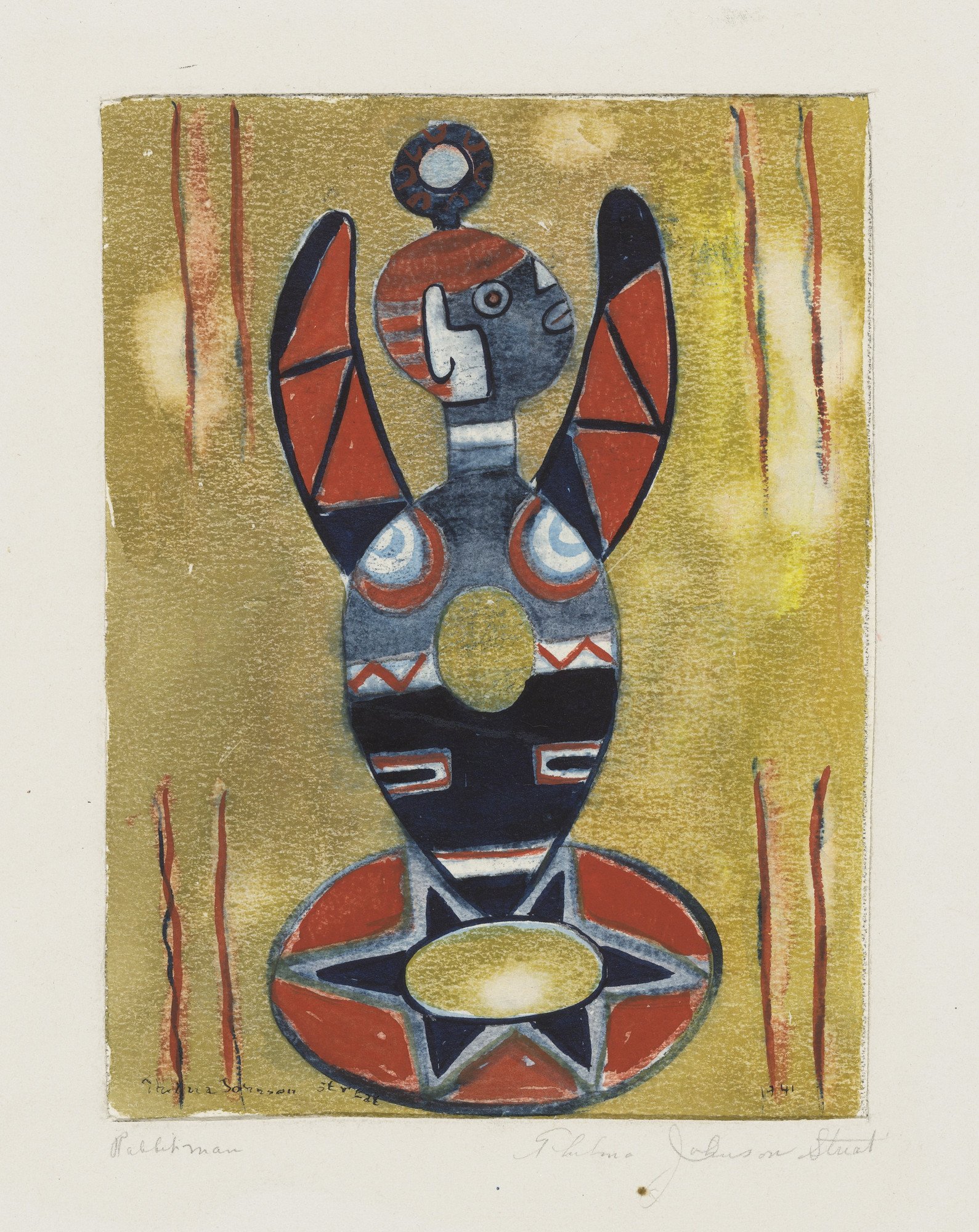
Figure 2. Thelma Johnson Streat, Rabbit Man, 1941, Gouache on board, 6 5/8 × 4 7/8" (16.8 × 12.4 cm), The Museum of Modern Art, accessed April 4th, 2025, https://www.moma.org/collection/works/35320.re
Spending more time with Streat’s artist files, I found myself increasingly frustrated by what felt like the institutional indifference surrounding her practice. That indifference perhaps explains why so little is left about her work despite her historic position as the first Black woman collected by a leading institution like the MoMA. Unpacking the correspondence preserved in her file suggests that while group exhibitions and performances offered moments of visibility, Streat was deeply invested in cultivating sustained critical engagement by way of solo exhibition in hopes of engaging with the full scope of her practice, particularly the relationship between movement and visual form. In 1947, five years after MoMA acquired Rabbit Man, Streat wrote to curator Dorothy Canning Miller regarding the possibility of exhibiting her recent work and performances at the museum. Miller’s response, while polite, was marked more by deferral than outright refusal, stating:
I am afraid there is no immediate possibility of a one-man exhibition at the Museum, nor have we any concerts or dance programs scheduled at the present time. This is something for the future, of course. I wish that I had some really good suggestions for you about a place to show in New York, but I assure you the situation here in art galleries is very difficult. The dealers all seem to have much more than they can handle and will not consider adding to their list of exhibitors (8).
Miller’s language sticks out to me for its slight distancing, marked by phrases such as “no immediate possibility” and “something for the future.” By framing Streat’s exclusion in logistical terms and situating the responsibility within the broader New York art market, Miller avoids directly addressing the museum’s curatorial practices and internal criteria. This kind of behavior while indirect feeds into the perpetual distancing that museums and institutions play when it comes to contending with what it means to include the work of Black artists, specifically Black women artists in their collections.
Conceptual artist and Kantian philosopher Adrian Piper gives language to the contradictions I have been tracing throughout this essay. In The Triple Negation of Colored Women Artists, Piper describes the dilemma institutions face when Black women artists enter these systems. Our presence, she argues, is treated as a “triple-barreled threat” because it unsettles the racial, gendered, and aesthetic assumptions through which the Western canon has secured its authority. The first of these threats challenges the mythology of European artistic inheritance itself (9). By positioning Europe as the primary site of artistic innovation, the art historical canon relegates non-Western traditions to the periphery while obscuring the historical conditions through which Europe accumulated cultural authority.
Barr’s genealogical diagram offers a clear example of this process, visualizing a hierarchy of artistic value in which Europe occupies the position of authorship while Black artistic traditions remain available for appropriation. The romanticization of European art history allows institutions to sidestep the extent to which this authority was built through extraction, dispossession, and rupture, severing Black people from their cultural lineages while transforming aspects of those traditions into resources for Western artistic advancement. Black women claiming space as artists rupture these narrow frameworks. As Piper suggests, our presence opens onto futurity, speculation, and social transformation precisely because it exceeds the categories meant to contain us (10). In this way, Black women’s artistic production emerges not as an addition to the Western canon, but as a corrective to its epistemic foundations.
This is why Thelma Johnson Streat’s Rabbit Man matters so deeply. Streat’s use of masquerade, folklore, movement, memory, and geometric form refuses the separation between aesthetic inquiry and lived experience demanded by formalist criticism. Her work demonstrates that visual experimentation can emerge from cultural knowledge, embodied practice, ancestral memory, and strategies of survival rather than in spite of them. Through her engagement with the body and performance, Streat offers an alternative theory of abstraction altogether. She reveals that abstraction does not have to mean departure from lived reality. It can also become a way of moving beyond imposed forms without severing oneself from the histories, communities, and systems of knowledge that give those forms meaning.
The reality is the MoMA could acquire Rabbit Man without fully recognizing the intellectual and creative world from which it was created. That gap between possession and recognition lies at the heart of the violence Piper names and resurfaces the concerns that have animated this essay from the outset.
Being written back into an art historical canon that was never built to hold us in the first place is not enough for me. Quite frankly, it’s boring. There’s still so much work to be done in cultivating our own ways of seeing and relating to the world, rooted in our own epistemologies, materials, and spiritual grammars. Far more generative to me is the possibility of building up those foundations and tending to the vast and lush gardens left behind by our foremothers. Such work requires devotion and stewardship. It asks us to reconsider what it means to be an artist altogether, moving beyond capitalist and individualist understandings of artistic production toward practices grounded in womanist, relational, and decolonial ways of being. As Black women continue to claim space as artists, we’ll inevitably face pressure to assimilate, to assume the position of a-politicalness, to bypass what has been built by our foremothers for the sake of recognition and legibility within systems that were never designed to see us fully.
But recognition in this system cannot be the horizon of our imagination. We must take a position because reality calls for it.
Aren’t you tired? Isn’t there something more?
Notes
Ngũgĩ wa Thiong’o, Decolonising the Mind: The Politics of Language in African Literature (London: James Currey, 1986).
Alfred Barr, “Abstract Art and Politics”, in Cubism and Abstract Art (The Museum of Modern Art, 1936), 18, www.moma.org/calendar/exhibitions/2748.
Alfred Barr, “Preface” in Cubism and Abstract Art (The Museum of Modern Art, 1936), 9, www.moma.org/calendar/exhibitions/2748.
“Cubism and Abstract Art Exhibition Page: Master Checklist,” Museum of Modern Art, accessed April 4, 2025, https://www.moma.org/calendar/exhibitions/2748.
Alfred Barr, “Introduction”, in Cubism and Abstract Art (The Museum of Modern Art, 1936), 11, www.moma.org/calendar/exhibitions/2748.
Abbe Schriber,“Mapping a New Humanism in the 1940s: Thelma Johnson Streat between Dance and Painting,” Arts 9, no. 1 (March 2020): 12-14, https://doi.org/10.3390/arts9010007.
Anne Eden Gibson, “Biographical Sketches of Artists,” in Abstract Expressionism: Other Politics (Yale University, 1997), 187.
Thelma Johnson Streat, Artist File, 1950, Museum of Modern Art, Archives Department, New York, NY, Box 12, Folder 4, Museum Archive.
Adrian Piper, “The Triple Negation of Colored Women Artists” in Feminism-Art-Theory: An Anthology
1968-2000, ed. Hilary Robinson (Blackwell Publishers, 2001), 60-61.
Piper,“The Triple Negation of Colored Women Artists,” 62.